The Internal Quality Assurance (IQA) Framework of the Posts and Telecommunications Institute of Technology (PTIT) has been developed as an integrated management and quality enhancement system to support the PTIT’s strategic transformation toward a smart digital university and an internationally recognized higher education institution.
The framework is designed based on international quality assurance principles, particularly the PDCA (Plan – Do – Check – Act) cycle, stakeholder-centered approaches, outcome-based education, and continuous quality improvement. It aligns with the requirements and orientations of international accreditation frameworks such as AUN-QA, ASIIN, ESG, and other global higher education quality standards.
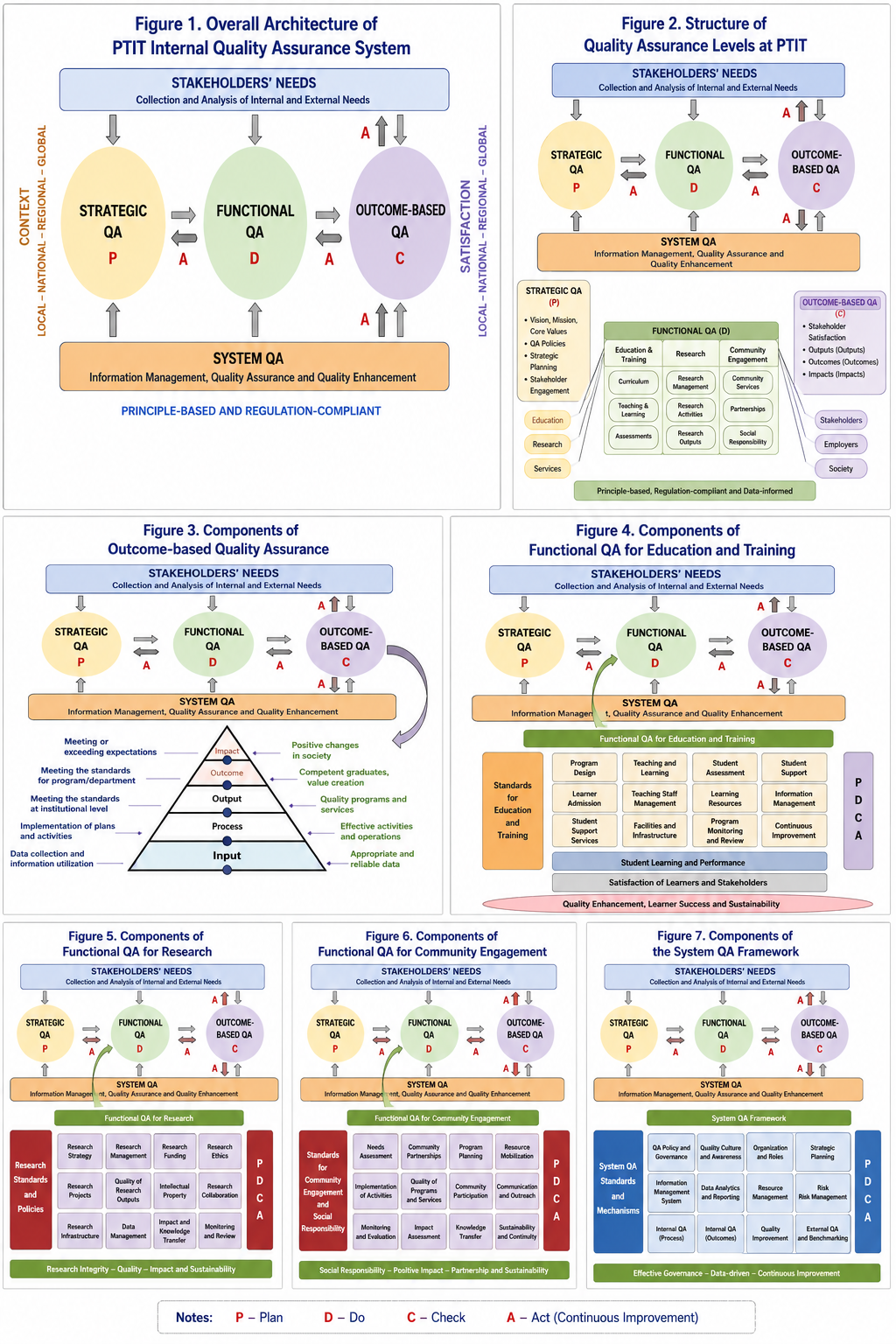
1. Philosophy and Principles of the IQA Framework
PTIT’s IQA Framework is established on the following core principles:
- Stakeholder-centered quality assurance;
- Continuous quality enhancement;
- Evidence-based management and decision-making;
- Integration of strategic, functional, and outcome-based quality assurance;
- Digital transformation and data-driven governance;
- Compliance with national regulations and international standards.
The framework emphasizes that quality is not only the responsibility of a specific unit but a shared institutional culture involving leadership, academic staff, administrative staff, students, alumni, employers, and external stakeholders.
2. Overall Architecture of the IQA Framework
The PTIT IQA Framework consists of four interconnected components:
a/ Strategic QA
Strategic QA focuses on institutional direction, long-term development, and quality governance. It includes:
- Vision, mission, and core values;
- Strategic planning;
- QA policies and governance mechanisms;
- Stakeholder engagement;
- Institutional leadership and management.
Strategic QA ensures that all quality assurance activities are aligned with PTIT’s long-term development objectives and internationalization strategy.
b/ Functional QA
Functional QA addresses the quality management of the PTIT’s core functions, including:
- Education and training;
- Research and innovation;
- Community engagement and services;
- Support services and administrative operations.
This component ensures that operational activities are effectively implemented, monitored, evaluated, and continuously improved according to institutional objectives and stakeholder expectations.
c/ Outcome-based QA
Outcome-based QA evaluates the effectiveness and impact of institutional activities through measurable outcomes and evidence-based assessment. Key dimensions include:
- Learning outcomes;
- Graduate employability;
- Research outputs and impacts;
- Stakeholder satisfaction;
- Social contributions and community impacts.
The outcome-based approach enables PTIT to assess not only operational performance but also the long-term value and societal impact generated by the PTIT.
d/ System QA
System QA serves as the foundational infrastructure supporting all QA activities across the PTIT. It includes:
- Information management systems;
- QA databases and digital dashboards;
- Internal monitoring and evaluation mechanisms;
- Quality enhancement processes;
- Data analytics and institutional reporting.
System QA enables PTIT to implement a comprehensive digital quality assurance ecosystem that supports evidence-based management and continuous institutional improvement.
3. Stakeholder-centered Quality Assurance
The PTIT IQA Framework adopts a stakeholder-centered approach in all quality assurance activities. Stakeholders include:
- Students and learners;
- Academic and administrative staff;
- Alumni;
- Employers and industry partners;
- Government agencies;
- Society and community partners.
Stakeholder needs and expectations are regularly collected, analyzed, and integrated into strategic planning, curriculum development, research activities, and institutional services.
This approach helps ensure the relevance, responsiveness, and sustainability of PTIT’s educational ecosystem.
4. Functional QA Areas
a/ QA for Education and Training
Quality assurance for education and training focuses on:
- Curriculum design and review;
- Teaching and learning processes;
- Student assessment;
- Learner support services;
- Learning resources and facilities;
- Teaching staff development;
- Continuous curriculum improvement.
PTIT adopts outcome-based education principles to ensure that graduates possess the competencies, knowledge, skills, and professional attributes required by the labor market and global society.
b/ QA for Research and Innovation
Quality assurance in research focuses on:
- Research strategy and policies;
- Research ethics and integrity;
- Research management systems;
- Scientific outputs and publications;
- Technology transfer and innovation;
- Research collaboration and partnerships;
- Research impact assessment.
The framework promotes research quality, innovation capacity, interdisciplinary collaboration, and international research integration.
c/ QA for Community Engagement and Services
Community engagement QA focuses on:
- Social responsibility;
- Community service activities;
- Industry collaboration;
- Sustainable development initiatives;
- Social impact assessment;
- Knowledge transfer and outreach activities.
This component reinforces PTIT’s role as a socially responsible higher education institution contributing to national and global development.
5. Continuous Quality Improvement
Continuous quality improvement is the central philosophy of the PTIT IQA Framework.
All QA activities are implemented according to the PDCA cycle:
- Plan (P): Strategic planning and quality objective setting;
- Do (D): Implementation of educational, research, and service activities;
- Check (C): Monitoring, evaluation, assessment, and analysis;
- Act (A): Improvement actions, innovation, and quality enhancement.
The PDCA approach ensures that quality assurance is not a one-time activity but an ongoing institutional process embedded in PTIT’s governance and operational culture.
6. Digital Transformation and Data-driven QA
As part of PTIT’s digital transformation strategy, the IQA Framework incorporates digital technologies and smart management systems into quality assurance processes.
Key initiatives include:
- Digital QA dashboards;
- Online stakeholder feedback systems;
- Learning analytics and AI-supported monitoring;
- Integrated institutional databases;
- Automated reporting and performance tracking systems.
These technologies improve transparency, responsiveness, operational efficiency, and evidence-based decision-making.
7. Commitment to International Standards
PTIT is committed to aligning its quality assurance system with international standards and best practices in higher education.
The PTIT continuously enhances its QA system to support:
- National accreditation;
- International program accreditation;
- Institutional benchmarking;
- Global university rankings;
- International academic cooperation and recognition.
Through its integrated IQA Framework, PTIT aims to foster a sustainable quality culture, enhance institutional competitiveness, and contribute to regional and global higher education development.