Objectives, Vision, Mission and Core Values
Overview
The Development Strategy of the Posts and Telecommunications Institute of Technology (PTIT) for 2026–2030, with a vision to 2045, was approved under Decision No. 4119/QĐ-BKHCN dated 14 October 2026, issued by the Minister of Science and Technology of Vietnam.
The Strategy defines PTIT’s development objectives, vision, mission, core values, strategic priorities and key performance targets for the period to 2030, with orientations to 2045.
Our Objectives
To develop PTIT into a national key higher education institution in engineering and technology, with a focus on digital technologies, and a specialized institution for education and research in science and technology, innovation and digital transformation under the Ministry of Science and Technology.
PTIT will play a pioneering role, within its authority, in piloting new mechanisms and policies and sandbox models for science and technology and innovation. The Institute aims to rank among leading universities in the region, with selected fields among Asia’s top 200 by 2030 and the world’s top 100 by 2045.
Our Vision
To become Vietnam’s leading new-generation technology university, with selected technology fields ranked among Asia’s top 200 by 2030 and the world’s top 100 by 2045; a place where technology talents, scientists and technology entrepreneurs develop their capabilities to master and create technologies, establish new value and lead the digital future.
Our Mission
To create and transfer knowledge to society by connecting high-quality human resource development with scientific research and innovation, contributing to a strong and prosperous Vietnam in the digital era.
Our Core Values
- Pioneering – Innovation
- Quality – Effectiveness
- Prestige – Responsibility
- Dedication – Compassion
Educational quality assurance is a key factor enabling PTIT to effectively achieve its strategic goals. It is a continuous process aimed at enhancing internal quality and improving the Institute’s standing at both national and international levels.
Structure of the Internal Quality Assurance System
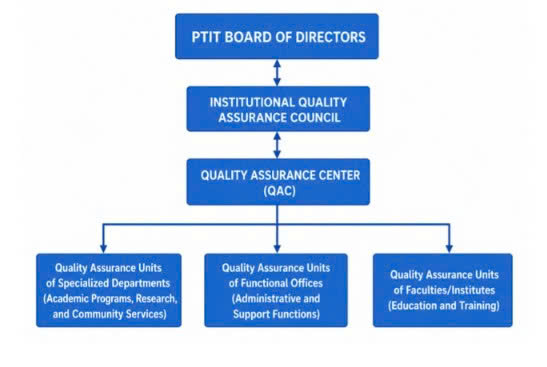
1. PTIT Quality Assurance Council
Serves as an advisory body to the Institute’s leadership on strategies, policies, and plans:
- Composition: Board of Directors, administrative departments, faculties, and industry representatives;
- Operations: Convenes periodically every six months to issue resolutions and monitor implementation.
2. Functional Units for Educational QA
- Center for Testing and Educational QA: Specialized unit responsible for managing all QA activities;
- Specialized Subcommittees: Working groups for academic programmes, research, and community services.
3. QA Units within Functional and Academic Units
QA Teams established at departments, faculties, and centers to ensure continuous improvement:
- Stakeholder Participation: Must include industry partners/alumni (min. 10% of total members);
- Responsibilities: Evidence management and reporting results using the RACI framework;
- Digital Integration: All evidence is stored using standardized formats within the Information Management System (IMS).
Continuous improvement for educational excellence.